







Warung Online
  • History of Robotics Timeline
  • Configuration Spaces, Braids, and Robotics
  • POZESTYS GUIDE TO TERRARIA
  • Health Benefits of Watermelon
  • PLC Programming Guide
  • The Programmable Logic Controller (The PLC)
  • Benefits of Green Tea
  • Robotics Essay
Showing posts with label Health. Show all posts

Benefits of Green Tea

Review
Beneficial Effects of Green Tea—A Review
Carmen Cabrera, PhD, Reyes Artacho, PhD, Rafael Gime´nez, PhD
Departamento de Nutricio´n y Bromatologı´a, Facultad de Farmacia, Universidad de Granada, Granada, SPAIN
Key words: green tea, polyphenols, catechins, antioxidant activity, human health
Tea is the most consumed drink in the world after water. Green tea is a ‘non-fermented’ tea, and contains
more catechins, than black tea or oolong tea. Catechins are in vitro and in vivo strong antioxidants. In addition,
its content of certain minerals and vitamins increases the antioxidant potential of this type of tea. Since ancient
times, green tea has been considered by the traditional Chinese medicine as a healthful beverage. Recent human
studies suggest that green tea may contribute to a reduction in the risk of cardiovascular disease and some forms
of cancer, as well as to the promotion of oral health and other physiological functions such as anti-hypertensive
effect, body weight control, antibacterial and antivirasic activity, solar ultraviolet protection, bone mineral
density increase, anti-fibrotic properties, and neuroprotective power. Increasing interest in its health benefits has
led to the inclusion of green tea in the group of beverages with functional properties. However, although all the
evidence from research on green tea is very promising, future studies are necessary to fully understand its
contributions to human health, and advise its regular consumption in Western diets, in which green tea
consumption is nowadays limited and sporadic.
Key teaching points:
• Green tea contains numerous components with antioxidant activity: polyphenols (especially catechins), minerals, vitamins.
• Green tea contains more catechins than black or oolong teas.
• The strong antioxidant potential of catechins, and especially EGCG, are widely demonstrated in vitro and in animal studies. In
addition, catechins possess antimutagenic, antidiabetic, anti-inflammatory, antibacterial and antiviral properties.
• Recent human studies suggest that green tea may contribute to reduce the risk of cardiovascular disease and cancer, and has another
beneficial effect on health.
• Although research of green tea is very promising, future studies considering dietetic, environmental and life style factors, are
necessary to fully understand its contribution to human health.
Pdf Link : click here

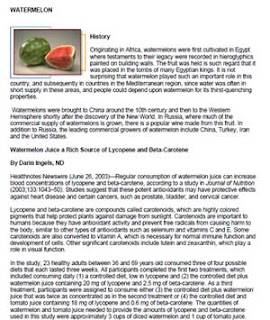
Health Benefits of Watermelon

Healthnotes Newswire (June 26, 2003)—Regular consumption of watermelon juice can increase
blood concentrations of lycopene and beta-carotene, according to a study in Journal of Nutrition
(2003;133:1043–50). Studies suggest that these potent antioxidants may have protective effects
against heart disease and certain cancers, such as prostate, bladder, and cervical cancer.
Lycopene and beta-carotene are compounds called carotenoids, which are highly colored
pigments that help protect plants against damage from sunlight. Carotenoids are important to
humans because they have antioxidant activity and prevent free radicals from causing harm to
the body, similar to other types of antioxidants such as selenium and vitamins C and E. Some
carotenoids are also converted to vitamin A, which is necessary for normal immune function and
development of cells. Other significant carotenoids include lutein and zeaxanthin, which play a
role in visual function.
In the study, 23 healthy adults between 36 and 69 years old consumed three of four possible
diets that each lasted three weeks. All participants completed the first two treatments, which
included consuming daily (1) a controlled diet, low in lycopene and (2) the controlled diet plus
watermelon juice containing 20 mg of lycopene and 2.5 mg of beta-carotene. As a third
treatment, participants were assigned to consume either (3) the controlled diet plus watermelon
juice that was twice as concentrated as in the second treatment or (4) the controlled diet and
tomato juice containing 18 mg of lycopene and 0.6 mg of beta-carotene. The quantities of
watermelon and tomato juice needed to provide the amounts of lycopene and beta-carotene
used in this study were approximately 3 cups of diced watermelon and 1 cup of tomato juice.
Blood levels of lycopene and beta-carotene were measured at the beginning and completion of
each three-week treatment period.
The watermelon juice diet increased blood concentrations of lycopene and beta-carotene almost
five-fold and two-fold, respectively, compared with the diet without watermelon juice. However,
there was no significant increase in lycopene or beta-carotene levels when the amount of
watermelon juice was doubled. Consumption of tomato juice produced a similar increase in
blood lycopene concentrations, but failed to increase beta-carotene levels.
Download Link : click here